Every WordPress site owner has a version of the same nightmare: you log in one morning, and there's a new administrator account you didn't create. The site now redirects to a pharmaceutical spam page, your Google rankings are gone, and your email is flooded with abuse complaints from your hosting provider. This isn't hypothetical. In 2023 and 2024, a string of vulnerabilities in popular plugins allowed attackers to grant themselves admin access with a single unauthenticated HTTP request.
The uncomfortable truth is that most of these breaches had nothing to do with weak passwords or brute-force attacks. They came from privilege escalation flaws inside plugins that millions of sites trusted. One infamous case affected a membership plugin installed on over 100,000 sites, letting anyone send a crafted POST request and walk away with an administrator role. No login required. That's what "one-click admin takeover" really means, and it's more common than the WordPress marketing copy would like you to believe.
This article is a practical, technical guide to wordpress plugin security. You'll learn how these takeover attacks actually work, how to audit your plugins before and after installing them, how to lock down the roles-and-capabilities system, and how to build a layered defense that survives the next zero-day. There are worked examples, a comparison table, and a step-by-step hardening walkthrough you can follow today.
Key Takeaways
- Privilege escalation is the real threat. Most admin takeovers exploit plugin functions that fail to check user roles or nonces, not stolen passwords.
- Audit before you install. A plugin's update cadence, code quality, and disclosure history predict its security future.
- Restrict who can even reach the login page. IP allowlisting and request filtering shrink your attack surface dramatically.
- Enforce least privilege. Most "editors" and "authors" do not need
manage_optionsor the ability to install plugins.- Layer your defenses. A web application firewall, integrity monitoring, and enforced 2FA each catch what the others miss.
- Monitor for new admin accounts. Alerting on role changes turns a silent breach into a 5-minute incident.
How One-Click Admin Takeover Attacks Actually Work
To defend against these attacks, you need to understand the mechanics. A one-click admin takeover almost always exploits one of three plugin coding failures.
1. Missing capability checks
WordPress functions like update_user_meta() or wp_insert_user() don't check permissions on their own. That's the developer's job. When a plugin exposes an AJAX action or REST endpoint that calls these functions without first verifying current_user_can('manage_options'), any visitor can trigger it.
The classic pattern looks like this: a plugin registers wp_ajax_nopriv_save_settings (the nopriv means unauthenticated users can call it) and inside that handler it writes user roles based on POST data. An attacker sends role=administrator and the plugin obediently promotes them.
2. Missing or reused nonces
Nonces are WordPress's cross-site request forgery (CSRF) tokens. A plugin that accepts state-changing requests without calling check_admin_referer() or wp_verify_nonce() can be tricked into acting on behalf of a logged-in admin who simply visited a malicious page.
3. Broken authentication logic
Some plugins implement their own login, social sign-in, or "magic link" flows. When that custom code compares tokens loosely, trusts client-supplied user IDs, or skips validation, attackers can authenticate as user ID 1, which is almost always the primary administrator.
The scary part is speed. Once a vulnerability is disclosed, automated scanners find exposed sites within hours. Wordfence has repeatedly documented millions of exploit attempts within 48 hours of a public advisory. If you're relying on "I'll update when I get around to it," you're already losing.
A Worked Example: The Cost of One Vulnerable Plugin
Let's put numbers to it. Say you run a small membership site with the following setup:
- Plugins installed: 23
- Plugins not updated in the last 90 days: 6
- Administrator accounts: 4 (two of them belong to former contractors)
- 2FA enabled: No
- Monthly revenue: $8,000 from subscriptions
Now a privilege escalation flaw is disclosed in one of your six stale plugins. Here's the realistic timeline of what happens next if you do nothing:
- Hour 0: Advisory published. CVE assigned. Exploit code circulates.
- Hour 6: Automated bots find your site and register a hidden admin account named something like
wp-admin-svc. - Hour 12: The attacker installs a malicious plugin containing a web shell and injects spam links into your published posts.
- Day 2: Google flags the site with a "This site may be hacked" warning. Organic traffic drops 60%.
- Day 3: Your host suspends the account for sending spam. The site goes dark.
- Days 3–10: You pay a remediation service $500 to $1,500, lose roughly $2,600 in subscription revenue, and spend a week rebuilding trust.
Now the before/after. With one hour of hardening in advance (automatic updates enabled, stale plugins removed, contractor accounts deleted, 2FA enforced, and an IP filter on /wp-admin), the same disclosure event is a non-event. The bot's request to your admin endpoint gets blocked before it reaches the vulnerable code, and even if it didn't, the attacker still can't create a new admin because your firewall flagged the role change. One hour of prevention versus a week and thousands of dollars of cleanup. That math never changes.
How to Audit a Plugin Before You Install It
The best defense starts before a plugin ever touches your server. Treat every install like hiring a contractor with root access, because that's effectively what it is. Our guide on how to audit open-source software before adding it to your stack covers the general framework, and it maps cleanly onto plugins.
Signals that predict a secure plugin
- Active maintenance. Look for updates within the last three months and compatibility with the current WordPress version.
- Responsible disclosure history. A plugin that has fixed CVEs quickly is often safer than one with zero reported issues, which frequently just means nobody looked.
- Reasonable install base. A plugin with 50,000+ active installs gets more security scrutiny from researchers.
- Clear changelog. Entries like "Fixed unauthenticated privilege escalation" show the developer takes security seriously and communicates it.
- Small, focused scope. A plugin that does one thing has less code to get wrong than an all-in-one suite.
Red flags to walk away from
- Last updated over a year ago
- Nulled or "free premium" versions from unofficial sites, which are a leading source of pre-installed backdoors
- Support forum full of unanswered "my site got hacked" threads
- Vague ownership with no company, no website, and no changelog
This is also why sourcing plugins matters. Downloading from a vetted marketplace rather than a random torrent removes an entire category of risk. If you're browsing the WordPress plugins category on a curated marketplace, you're already avoiding the nulled-software trap that infects so many budget-conscious site owners.
Comparing WordPress Hardening Approaches
There's no single tool that solves plugin security. Each approach covers a different layer. Here's how the main strategies stack up.
| Approach | Blocks unauth exploits | Stops privilege escalation | Effort to set up | Ongoing maintenance |
|---|---|---|---|---|
| Manual updates only | Partial (after patch) | No | Low | High (constant vigilance) |
| Web application firewall (WAF) | Yes | Partial | Medium | Low |
| IP allowlisting on /wp-admin | Yes (for targeted paths) | Yes (blocks the request) | Low | Low |
| Role/capability lockdown | No | Yes | Medium | Low |
| File integrity monitoring | No (detects, not prevents) | Detects after the fact | Medium | Low |
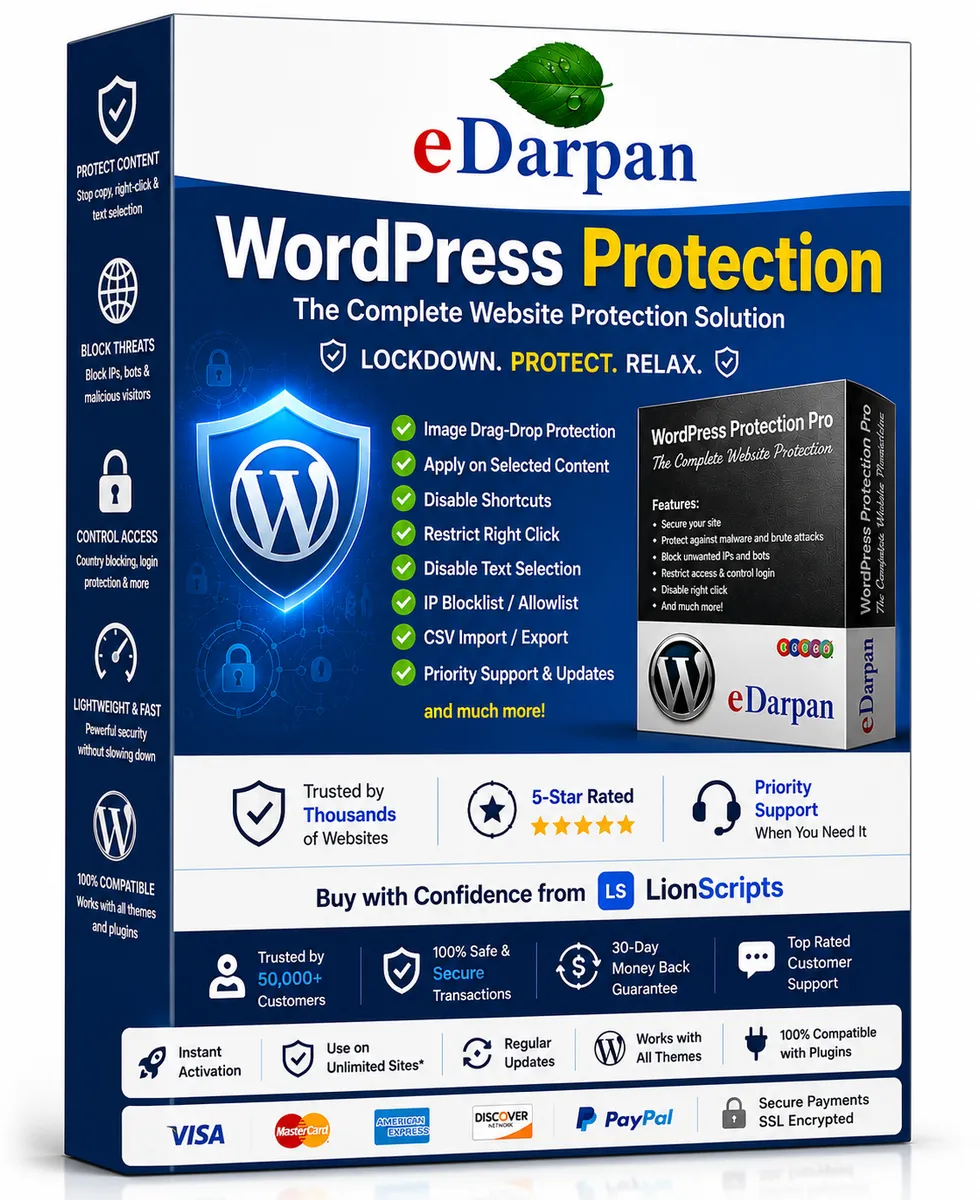
The lesson from this table is that no single row scores well across every column. A WAF is great at blocking known exploit signatures but can miss a brand-new privilege escalation flaw. IP allowlisting is cheap and brutally effective for admin paths but useless against front-end vulnerabilities. Layering is the answer, and dedicated tools such as eDarpan WordPress Protection exist precisely because bundling these layers manually is fiddly.
Step-by-Step: Hardening Your WordPress Install Against Takeover
Here's the walkthrough. You can do all of this in an afternoon, and you don't need to be a developer.
Step 1: Enforce least privilege on every account
- Go to Users → All Users and count your administrators. Most sites need one or two, not five.
- Downgrade anyone who only writes content to Author or Editor.
- Delete accounts belonging to former staff or contractors immediately. Reassign their content during deletion.
- Rename the default
adminusername if it still exists. Attackers guess it first.
Step 2: Turn on automatic updates for plugins
- Under Plugins, enable auto-updates for every plugin you trust.
- For a few critical plugins where a bad update could break the site, keep
Cover image: Innovate Maryland Emerging Technology Center by MDGovpics, licensed under BY 2.0 via Openverse.