Here's an uncomfortable statistic: according to multiple industry surveys, roughly 30% of people have never backed up their computer, and among those who do, the majority rely on a single copy sitting on one external drive. That drive is one coffee spill, one ransomware infection, or one theft away from taking your entire digital life with it. If your only backup lives in the same room as your laptop, you don't have a backup strategy. You have a hope.
The good news is that in 2026, building a genuinely resilient backup system is cheaper and more automated than it has ever been. You can encrypt everything before it leaves your machine, push one copy to a local NAS or external drive, send another to cloud storage, and never think about it again after the initial setup. The tools have matured, the encryption is battle-tested, and the whole thing can run silently in the background.
In this guide I'll walk you through exactly how to automate encrypted backups to both local and cloud destinations. We'll cover the 3-2-1 rule, the specific tools I actually use, a step-by-step setup you can copy, a comparison of the leading backup programs, and the mistakes that quietly wreck people's recovery when they need it most.
Key Takeaways
- Follow the 3-2-1 rule: 3 copies of your data, on 2 different media types, with 1 copy offsite (usually cloud).
- Always encrypt before data leaves your machine. Client-side encryption means the cloud provider never sees your files in readable form.
- Use a tool that does incremental, deduplicated backups so daily runs take seconds, not hours.
- Automate the schedule and set up failure notifications. A backup you have to remember to run is a backup that eventually stops running.
- Test a restore at least twice a year. An untested backup is an assumption, not a safety net.
- Store your encryption passphrase and recovery key somewhere separate from the backups themselves.
Why Encrypted, Automated Backups Matter More Than Ever
Ransomware is the reason this topic went from "nice to have" to "non-negotiable." Modern ransomware doesn't just encrypt your working files. It actively hunts for connected backup drives and network shares and encrypts those too. If your backup drive is always plugged in and always writable, an attacker owns it the moment they own your PC.
Encryption solves a different but equally important problem: privacy of the backup itself. When you push data to a cloud provider, you're trusting that provider's security. Client-side encryption removes that trust requirement. Even if the provider is breached, your data is an unreadable blob without your passphrase.
There's also a growing legal and regulatory angle. If you handle client records, financial documents, or anything covered by privacy rules, encrypted backups are increasingly expected rather than optional. The same logic that drives people to encrypt files inside images with steganography applies at scale: assume the storage medium can be compromised, and protect the data itself.
The 3-2-1 Rule Explained (And Why It Still Wins in 2026)
The 3-2-1 rule is old, but it survives because it maps cleanly onto real failure modes. Here's what it means in practice:
- 3 copies of your data. The original on your PC, plus two backups.
- 2 different media types. For example, an external SSD plus cloud storage. Don't put both backups on identical drives from the same batch.
- 1 copy offsite. If your house floods or burns, the offsite copy is what saves you. Cloud is the easiest way to satisfy this.
A modern refinement adds a fourth digit, making it 3-2-1-1-0: one copy should be immutable or offline (air-gapped), and you should have zero errors after verifying a test restore. Immutability is what defeats ransomware, because a copy that cannot be overwritten cannot be encrypted by an attacker.
A concrete worked example
Say you're a freelance designer with 240 GB of active files: client projects, invoices, and a photo library. Here's a realistic 3-2-1 setup and what it costs:
- Copy 1 (original): your laptop's internal SSD. Free.
- Copy 2 (local): a 1 TB external SSD, roughly $70 one time. Encrypted, incremental daily backups.
- Copy 3 (cloud, offsite + immutable): object storage with versioning enabled, around $1.20 per month for 240 GB on a low-cost provider like Backblaze B2 or Wasabi.
Total: about $70 up front and roughly $15 a year ongoing. For a business whose entire income depends on those files, that's astonishingly cheap insurance. The first full cloud upload might take a few hours on a decent connection, but after that only changed data goes up, so daily runs finish in seconds.
Choosing Your Backup Tool: A Practical Comparison
The tool you pick matters because it determines your encryption model, how efficient your backups are, and whether you'll actually stick with it. I've grouped the four options I recommend most often below. All support client-side encryption and can target both local and cloud destinations.
| Tool | Encryption | Dedup / Incremental | Ease of Setup | Best For |
|---|---|---|---|---|
| Restic | AES-256, client-side | Yes, block-level dedup | Moderate (CLI) | Technical users who want scriptable control |
| Duplicati | AES-256, client-side | Yes, incremental | Easy (web GUI) | Home users who want a dashboard |
| Kopia | AES-256 / ChaCha20 | Yes, strong dedup | Moderate (GUI + CLI) | Users wanting speed and a modern interface |
| Veeam Agent (Free) | AES-256, optional | Yes, image-level | Easy (Windows GUI) | Full-disk / bare-metal recovery |
My personal default is Restic for its reliability and the fact that its repository format is well documented and cross-platform. If you'd rather click buttons than write a command, Duplicati or Kopia give you a friendly interface without giving up strong encryption. If your priority is recovering an entire machine from scratch, a full image tool like Veeam Agent is worth adding alongside a file-level tool.
What "client-side encryption" actually means
Client-side (also called end-to-end) encryption means your files are encrypted on your computer using a key derived from your passphrase before they're transmitted. The cloud provider stores ciphertext only. Compare that to "encryption at rest," where the provider holds the keys and could, in theory, decrypt your data. For backups, always insist on client-side.
Step-by-Step: Automating Encrypted Backups With Restic
Here's a complete walkthrough you can follow on Windows, macOS, or Linux. I'll use Restic with a local drive and Backblaze B2 as the cloud target. Adjust paths to your system.
-
Install Restic. On Windows, download the binary and place
restic.exesomewhere on your PATH, or install viawinget install restic.restic. On macOS usebrew install restic. On Linux use your package manager. - Choose a strong passphrase. Generate something long and random, such as a 5-word passphrase, and store it in your password manager. This single secret protects everything. Losing it means losing your backups permanently, so also keep an offline copy.
-
Initialize the local repository. Plug in your external drive (say it mounts as
E:) and run:restic -r E:\backups init
Restic will prompt for your passphrase and create an encrypted repository. -
Run your first local backup. Point it at the folders that matter:
restic -r E:\backups backup C:\Users\you\Documents C:\Users\you\Pictures
The first run reads everything. Subsequent runs only add changed blocks. -
Create the cloud repository. Sign up for Backblaze B2, create a bucket with object lock / versioning enabled, and generate an application key. Set environment variables for the key ID and secret, then run:
restic -r b2:your-bucket-name init -
Back up to the cloud. Same command, new target:
restic -r b2:your-bucket-name backup C:\Users\you\Documents C:\Users\you\Pictures -
Set a retention policy. Keep the last 7 daily, 4 weekly, and 12 monthly snapshots, then prune old data:
restic -r b2:your-bucket-name forget --keep-daily 7 --keep-weekly 4 --keep-monthly 12 --prune -
Automate the schedule. On Windows, wrap the commands in a
.bator PowerShell script and create a Task Scheduler job that runs daily at, say, 1 AM. On macOS/Linux, use a cron job or a launchd/systemd timer. Have the script run the local backup, then the cloud backup, then the prune. - Add failure notifications. Pipe the script output to a log file and use a service like Healthchecks.io: your script pings a URL on success, and if the ping doesn't arrive on schedule, you get an email. This is the step most people skip and later regret.
-
Test a restore. Pick a random file and recover it to a temporary folder:
restic -r b2:your-bucket-name restore latest --target C:\restore-test --include Documents\some-file.pdf
Open the file and confirm it's intact.
If managing symlinks or junction points across drives complicates your folder layout, a small utility like Windows Symlink Creator Pro can help you consolidate paths so your backup scope stays clean. It lives among our other desktop utilities if you want to browse similar tools.
Local vs Cloud: Which Should Run First?
People often ask whether local or cloud backups matter more. The honest answer is you need both, but they solve different problems.
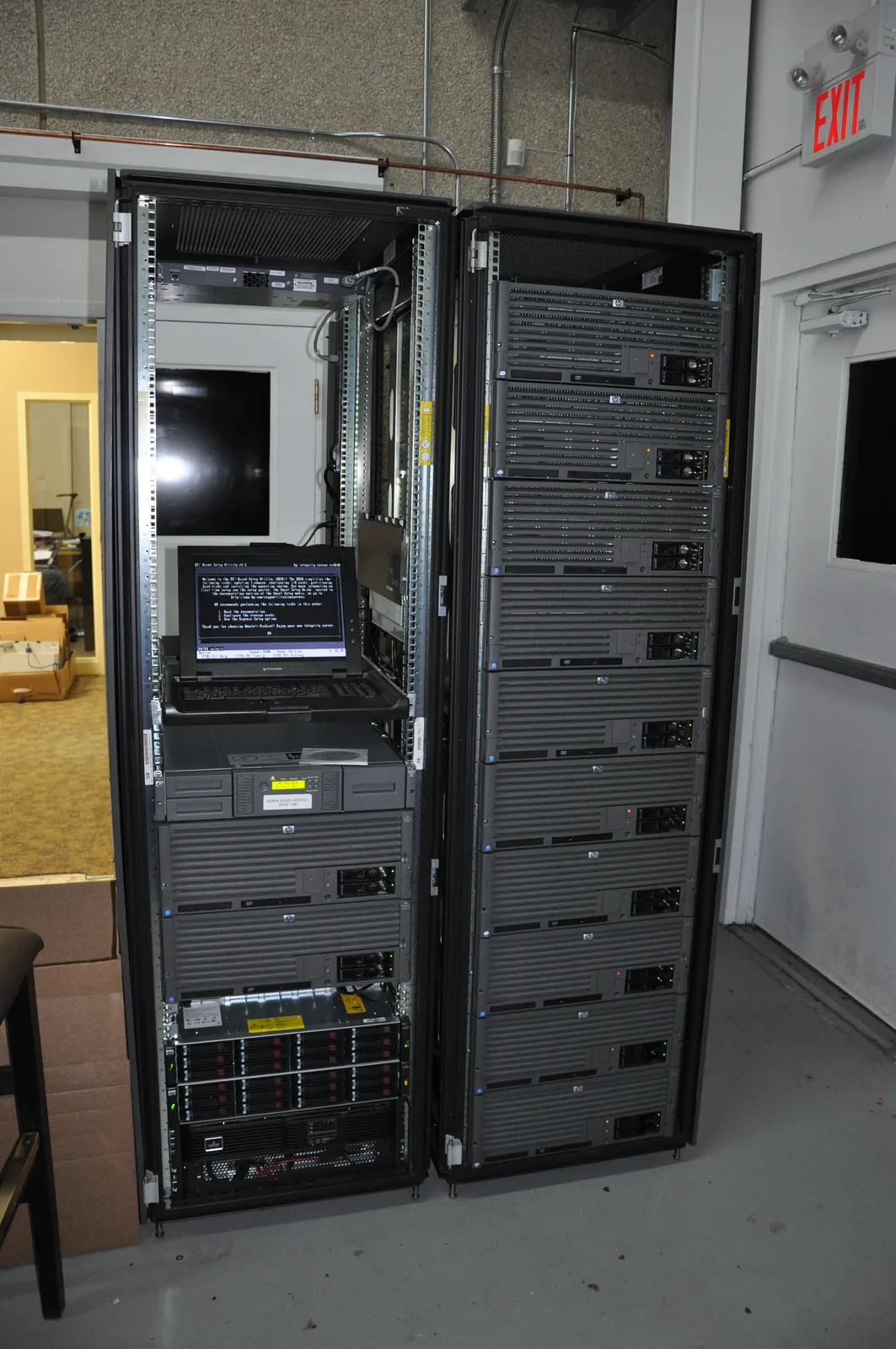
Cover image: HP Integrity rx4640 Series by Cdr. Trevor D. Biscope, CA Emerit, licensed under BY-SA 4.0 via Openverse.