Here is an uncomfortable truth most IT teams know but rarely say out loud: the breach that hits you next year will almost certainly exploit a vulnerability that already has a patch. According to years of Verizon DBIR data and Mandiant incident reports, unpatched known vulnerabilities remain one of the top initial access vectors, and the median time attackers take to weaponize a new CVE has dropped to a handful of days. Meanwhile, the average enterprise takes weeks to fully remediate.
That gap between "patch available" and "patch deployed" is where ransomware crews live. It is also entirely solvable. The bottleneck is almost never the patch itself. It is discovery, prioritization, testing, deployment, and verification across hundreds or thousands of assets that run different operating systems, third-party apps, and dependencies nobody documented.
This is where patch management software earns its keep. In this guide I will walk through what these tools actually do, compare the leading options for 2026 across the criteria that matter, show a worked example of how a patch backlog costs real money, and give you a step-by-step rollout plan you can run this quarter. I have deployed or evaluated most of these tools in production, so I will be honest about the tradeoffs.
Key Takeaways
- Patch management software automates the discovery, prioritization, deployment, and verification of security and feature updates across your entire fleet.
- The fastest wins come from third-party app patching (Chrome, Java, Adobe, Zoom), not just OS updates. These are where most exploited vulnerabilities hide.
- Risk-based prioritization using CVSS plus real exploit data (like CISA's KEV catalog) beats "patch everything" every time.
- For 2026, the split is clear: Automox and NinjaOne lead for cloud-native fleets, ManageEngine for on-prem control, and Action1 for cost-conscious teams.
- Patching is one layer. Pair it with hardened application security, immutable backups, and supply-chain vetting for real resilience.
- Always ring-deploy: test group first, then pilot, then broad rollout, with automatic rollback triggers.
What Patch Management Software Actually Does
At its core, patch management software answers four questions continuously: What do I have? What is out of date? What is dangerous? And how do I fix it safely at scale?
A modern platform handles the full lifecycle rather than just pushing Windows Updates. The mature capabilities you should expect in 2026:
- Asset discovery — agent-based or agentless inventory of every endpoint, server, and the software installed on it.
- Vulnerability correlation — mapping installed versions to known CVEs and, critically, to exploit intelligence.
- Third-party patching — updating hundreds of non-Microsoft apps, which is where most real-world risk concentrates.
- Automated deployment — scheduled, ring-based rollouts with maintenance windows and bandwidth throttling.
- Testing and rollback — pilot groups and automatic reversion when a patch breaks something.
- Reporting and compliance — audit-ready evidence for SOC 2, ISO 27001, HIPAA, or PCI DSS.
If a tool only patches the operating system, treat it as a starting point, not a solution. The teams that get breached usually had OS patching handled and an eight-month-old Java runtime sitting on a jump box.
Why Patching Is a Business Problem, Not Just an IT Task
Let me put numbers to the vague anxiety. Consider a mid-sized company with 500 endpoints and no automated patch management.
The before scenario
The IT team patches manually during a monthly maintenance window. Each cycle, a technician spends roughly:
- 6 hours identifying which machines missed the last cycle
- 10 hours scripting and pushing updates for third-party apps
- 8 hours chasing the 60 or so laptops that were offline or roaming
- 4 hours troubleshooting two or three apps that broke
That is 28 hours a month, about 336 hours a year. At a loaded rate of $60 per hour, that is $20,160 annually in labor alone. Worse, the roaming laptops routinely sit 30 to 45 days behind on Chrome and Zoom patches, which are precisely the browser and conferencing apps attackers love.
The after scenario
Deploy a cloud-native patch platform. Discovery is automatic and continuous. Roaming laptops patch over the internet without a VPN. Third-party apps update on policy. The technician's monthly involvement drops to roughly 4 hours of reviewing dashboards and approving exceptions.
Labor falls to about 48 hours a year, near $2,880. Tool cost for 500 endpoints runs somewhere between $1,500 and $6,000 annually depending on vendor. Even at the high end, you save money and shrink your mean time to remediate from 30-plus days to under 72 hours. That single change removes the most common ransomware entry point.
The math is rarely close. The reason teams delay is not cost. It is inertia and the fear of a bad patch taking down production. Modern tooling solves both with staged rollouts and rollback.
Best Patch Management Software Compared for 2026
I evaluated the leading tools on the criteria that separate a smooth rollout from a support nightmare: deployment model, third-party app coverage, automation depth, reporting, and pricing transparency. Here is how the front-runners stack up.
| Tool | Best for | Deployment | Third-party apps | Risk prioritization | Pricing model |
|---|---|---|---|---|---|
| Automox | Cloud-first, distributed fleets | Cloud, agent-based | Excellent (Worklets scripting) | Good, CVSS + custom | Per endpoint / month |
| NinjaOne | MSPs and lean IT teams | Cloud, agent-based | Very good, curated catalog | Good | Per endpoint, quote-based |
| ManageEngine Patch Manager Plus | On-prem and hybrid control | On-prem or cloud | Excellent (850+ apps) | Good | Tiered annual license |
| Action1 | Cost-conscious, SMB | Cloud, agent-based | Very good | Decent, CVSS-based | Free to 200 endpoints |
| Tanium | Large enterprise, real-time scale | Hybrid, linear-chain agents | Good | Excellent, real-time | Enterprise contract |
Automox vs NinjaOne: the cloud-native fight
Both are genuinely good. Automox shines when you want scripting flexibility. Its Worklets let you run arbitrary remediation, not just apply patches, which is powerful for cleaning up misconfigurations. NinjaOne wins on the integrated experience: RMM, monitoring, and patching in one pane, which is why managed service providers love it. If you are a single IT team managing your own fleet, either works. If you resell IT services, lean NinjaOne.
When on-prem still wins
ManageEngine Patch Manager Plus remains the pick for organizations that cannot or will not send inventory data to a vendor cloud, such as defense contractors and certain healthcare setups. Its third-party catalog is huge, and the on-prem license predictability appeals to finance teams. The tradeoff is you maintain the infrastructure and patch roaming devices through a gateway.
Action1 for the budget-first team
Action1 being free up to 200 endpoints is not a gimmick. For a small business or a lab, it is a fully capable cloud patch tool at zero cost. Above 200 endpoints the per-seat pricing is competitive. It lacks the deep scripting of Automox, but for pure patching it holds its own.
How to Prioritize Patches Without Losing Your Mind
You cannot patch everything at once, and you should not try. Microsoft alone ships dozens of fixes on Patch Tuesday. The winning strategy is risk-based prioritization.
The signal that matters most is not raw CVSS score. It is active exploitation. A CVSS 7.5 that is being exploited in the wild is more urgent than a CVSS 9.8 with no known exploit code. Use these sources in order:
- CISA Known Exploited Vulnerabilities (KEV) catalog — if a CVE is on this list, patch it now regardless of score.
- EPSS (Exploit Prediction Scoring System) — a probability that a vulnerability will be exploited in the next 30 days.
- CVSS base score — useful for triage, but never the sole factor.
- Asset exposure — an internet-facing web server outranks an air-gapped kiosk.
Good patch management software surfaces this intelligence automatically. If yours does not, cross-reference the KEV catalog manually each week. It takes ten minutes and prevents the worst outcomes.
This same prioritization logic applies to your web platforms. If you run WordPress, the plugin layer is your biggest attack surface, and I have written before about how to audit vulnerable WordPress plugins before a breach and why supply chain attacks on plugin updates deserve their own vetting workflow.
A Step-by-Step Patch Rollout Playbook
Here is the exact process I use to deploy patches at scale without waking up to a broken fleet. Follow it and you can run a safe rollout even on a large network.
- Build your asset inventory first. You cannot patch what you cannot see. Deploy agents to every device and confirm the inventory matches your asset register. Investigate anything unexpected.
- Define deployment rings. Create three or four groups:
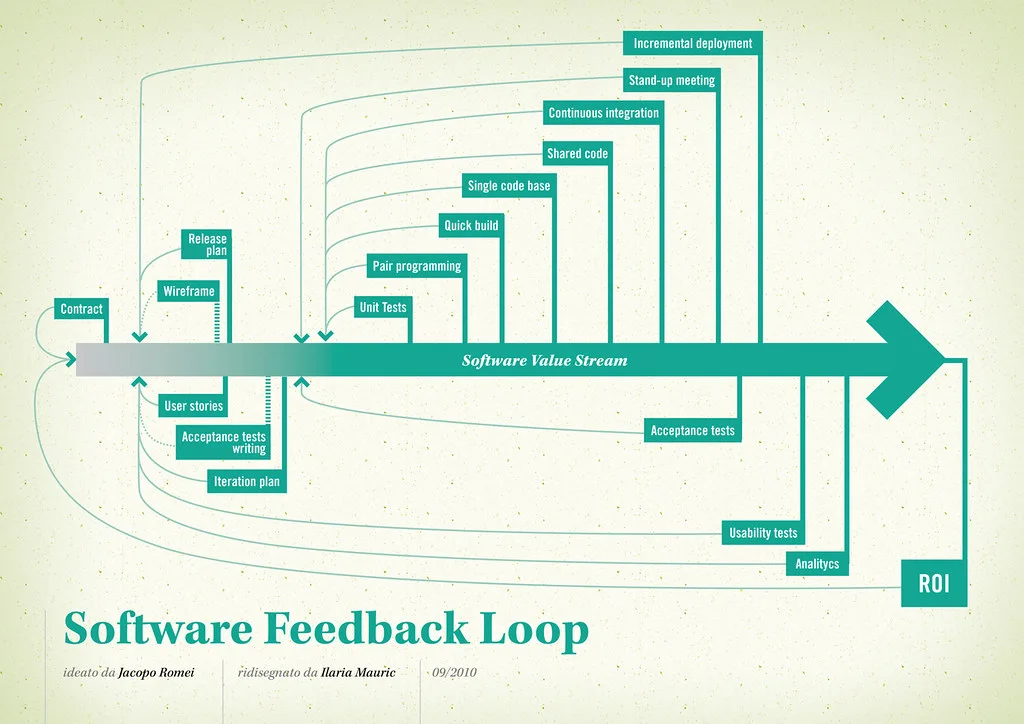
Test(5 to 10 IT-owned machines),Pilot(5%Cover image: Software value feedback loop by jakuza, licensed under BY-SA 2.0 via Openverse.