Most people carry around a small pile of subscriptions they barely use. A task app here, a habit tracker there, a budgeting tool, a CRM they abandoned in month two. The average knowledge worker touches nine different apps just to get through a normal Tuesday, and the mental cost of switching between them is real. Researchers at the University of California found that after an interruption it takes over 23 minutes to get back to focused work. Multiply that by every app you toggle into and out of, and you start to understand why productivity software so often makes us feel less productive.
There is a quieter alternative that has been sitting on your desktop the whole time: the spreadsheet. Pair a good spreadsheet with an AI assistant, and you can rebuild most of those single-purpose apps as flexible, private, tools you actually control. This is the heart of ai spreadsheet automation, and it is one of the most underrated skills you can pick up this year.
In this guide I will show you exactly how to combine AI assistants with Google Sheets and Excel to replace common productivity apps, with a worked example, a comparison of the main AI options, and a step-by-step build you can copy today. I have used every workflow here on my own work, so I will be honest about the tradeoffs too.
Key Takeaways
- A spreadsheet plus an AI assistant can replace task managers, habit trackers, simple CRMs, and budgeting apps, often for a fraction of the cost.
- The real leverage comes from formulas AI writes for you, not just chat: think
QUERY,ARRAYFORMULA, and Apps Script.- Keep your data local or in one trusted cloud. Fewer apps means a smaller attack surface and fewer OAuth permissions to worry about.
- Start with one workflow, prove it works for two weeks, then expand. Do not migrate everything at once.
- AI is excellent at generating formulas and structure, but you still own the logic and the review. Treat every output as a draft.
Why spreadsheets beat single-purpose productivity apps
A dedicated app decides how you work. A spreadsheet lets you decide. That flexibility used to come with a steep price: you had to know the formulas, the pivot tables, and the scripting. AI removes that barrier almost entirely.
Here is what a spreadsheet gives you that a typical app does not:
- Ownership. Your data lives in a file you control, exportable in seconds. No vendor lock-in, no "export blocked on the free plan."
- Composability. One sheet can pull from another. A budget can feed a dashboard which feeds a monthly summary, all without integrations.
- Cost. If you already pay for Google Workspace or Microsoft 365, marginal cost is zero. That $8/month habit tracker adds up to nearly $100 a year for a checkbox and a streak counter.
- Privacy. Fewer apps means fewer places your data leaks from. Every SaaS tool you cancel is one less breach notification waiting to happen.
The tradeoff is honest: spreadsheets have no push notifications, no polished mobile UX, and no built-in reminders unless you script them. For a lot of workflows, that is a fair trade. For others it is not, and I will flag those.
What "AI spreadsheet automation" actually means
The phrase gets thrown around loosely, so let me define it clearly. AI spreadsheet automation is the practice of using an AI assistant to generate, explain, and maintain the formulas, scripts, and structure that turn a blank grid into a working tool. It breaks into three layers.
Layer 1: AI as a formula writer
You describe what you want in plain English, and the AI returns a formula. "Sum column C where column A is this month and column B says paid" becomes a SUMIFS in seconds. This is the fastest win and works with any chat assistant, no special integration required.
Layer 2: AI inside the sheet
Both Google Sheets (Gemini) and Excel (Copilot) now embed AI directly. You can highlight a range and ask for a summary, a chart, or a cleanup. Third-party add-ons from the Google Sheets add-ons and Excel plugins categories extend this further with custom functions like =GPT().
Layer 3: AI-generated automation scripts
This is where you replace apps. AI writes Google Apps Script or Office Scripts that send emails, create calendar events, or fire reminders on a schedule. This is the layer that gives a spreadsheet the "app-like" behavior most people think only apps can do.
A worked example: replacing a $12/month task app with one sheet
Let me make this concrete. Say you use a popular task manager at $12/month, that is $144 a year, and you mostly use four features: a task list, due dates, priority tags, and a daily email of what is due. Here is how I rebuilt that in about 25 minutes.
Step 1: Build the structure
- Open a new Google Sheet and name it
Tasks. - Add these column headers in row 1:
Task,Project,Priority,Due Date,Status,Notes. - Select the
Prioritycolumn, go to Data then Data validation, and add a dropdown withHigh,Medium,Low. - Do the same for
StatuswithTodo,Doing,Done.
Step 2: Let AI write the "due today" view
Open a second tab called Today. Ask your AI assistant: "Write a Google Sheets QUERY formula that pulls rows from the Tasks tab where Due Date is today and Status is not Done, sorted by Priority." You will get something like:
=QUERY(Tasks!A2:F, "SELECT A, B, C, D WHERE D = date '"&TEXT(TODAY(),"yyyy-mm-dd")&"' AND E != 'Done' ORDER BY C", 0)
Paste it, adjust the ranges, and you have a live filtered view that updates every morning. No app needed.
Step 3: Add the daily email reminder
Now the part that feels like magic. Ask the AI: "Write a Google Apps Script that reads the Today tab and emails me a bulleted list of tasks every weekday at 7am." It will produce a function using MailApp.sendEmail plus a time-driven trigger. Paste it into Extensions then Apps Script, authorize it, and set the trigger.
The before and after: I went from a $144/year subscription to a $0 sheet that does the four things I actually used. The migration took less time than one episode of a TV show. Before you paste any script an assistant hands you, though, it is worth reading it the way you would verify open-source software before adding it to your stack. AI-generated code deserves the same scrutiny.
Which AI assistant should you pair with your spreadsheet?
Not all assistants are equal for this work. Some live inside the sheet, some are chat-only, and they differ sharply on how well they write formulas versus scripts. Here is how the main options compare based on my day-to-day use.
| Assistant | Lives in sheet? | Formula quality | Script generation | Best for |
|---|---|---|---|---|
| Gemini in Sheets | Yes (Google Sheets) | Very good | Good | Native Google Workspace users |
| Copilot in Excel | Yes (Excel 365) | Very good | Fair (Office Scripts) | Microsoft-heavy teams |
| ChatGPT (chat) | No, copy/paste | Excellent | Excellent | Complex formulas and Apps Script |
| Claude (chat) | No, copy/paste | Excellent | Excellent | Long scripts and explanations |
| Add-on functions (=GPT) | Yes, as a function | Depends on model | N/A | Bulk text tasks per row |
My honest recommendation: use an in-sheet assistant for quick edits, and keep a chat assistant open in a browser tab for anything involving scripts or multi-step logic. The chat models are still noticeably better at writing correct Apps Script the first time. You can browse dedicated AI tools if you want a purpose-built option rather than a general chatbot.
Five productivity apps you can replace right now
Beyond task management, here are the workflows I have successfully moved into spreadsheets, with the AI prompt that gets you started.
1. Habit tracker
Create a grid with dates down the side and habits across the top. Ask AI for a formula that counts your current streak and a conditional formatting rule that turns a cell green when marked done. Total build time: 10 minutes.
2. Simple CRM
Columns for contact, company, last touch date, and next action. Ask AI for a formula flagging any contact you have not spoken to in 30 days: =IF(TODAY()-D2>30,"Follow up",""). This alone replaced a bloated CRM I paid for annually.
3. Budget and expense tracker
One tab for transactions, one for a dashboard. Ask AI for a pivot-style summary by category and month. Add a SPARKLINE for a tiny trend chart in each row. Pair it with the CalculatorX utility when you need quick side calculations without touching the sheet.
4. Meeting notes and action items
Paste raw notes into a cell, then use an AI add-on function to extract action items into a structured list. This is the kind of text task where an in-sheet =GPT() function shines.
5. Content or project pipeline
A kanban board is just columns with a status field. Use data validation for stages and a QUERY per stage to build views. For pasting and reusing chunks of text across cells and documents, a clipboard tool like LionPaste saves a surprising amount of friction.
How to keep your spreadsheet system secure and
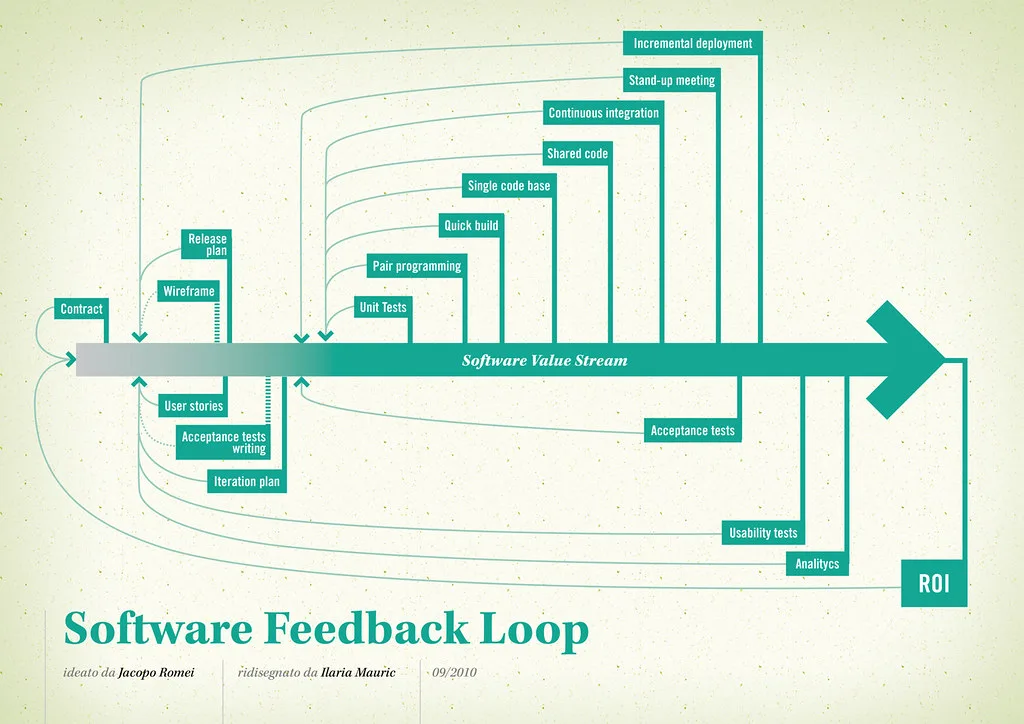
Cover image: Software value feedback loop by jakuza, licensed under BY-SA 2.0 via Openverse.