Every online store hits the same wall eventually: the day your shipping process stops being a rounding error and starts being the thing that breaks. Maybe it's the holiday rush when your order volume triples. Maybe it's the moment you add a second warehouse, or a new carrier, or start shipping internationally and realize customs paperwork is now your problem. The software that felt fine at 20 orders a day starts leaking money and time at 200.
Here's a number that surprises most founders: according to multiple logistics surveys, shipping and fulfillment errors cost merchants somewhere between 3% and 5% of total revenue once you account for reshipments, refunds, and support tickets. On a store doing $1M a year, that's up to $50,000 quietly evaporating because a label printed wrong or a rate got miscalculated. The right ecommerce shipping software doesn't just print labels. It's the operational backbone that decides whether your margins survive scale.
In this guide I'll walk you through exactly how to evaluate shipping platforms in 2026, what "scalable" actually means when you read the fine print, a real cost comparison of the main players, and a step-by-step process for switching without breaking your fulfillment on day one.
Key Takeaways
- Scalability is about throughput and integrations, not features. Count how many orders per hour a platform can batch-process and how many carriers and sales channels it connects natively.
- Per-label pricing kills you at volume. Model your costs at 3x your current volume before you commit, not at today's numbers.
- Rate shopping is the highest-ROI feature. Automatically comparing carriers per shipment routinely cuts postage 10–20%.
- API access and webhooks are non-negotiable if you plan to add a WMS, 3PL, or custom dashboard later.
- Audit any plugin or extension for security before it touches customer address and payment data.
- Plan the migration in a sandbox and run parallel for a week before cutting over.
What eCommerce Shipping Software Actually Does
At its core, shipping software sits between your store and your carriers. It pulls in orders, fetches live rates, generates labels, tracks packages, and pushes tracking numbers back to the customer. That's the baseline. Where platforms differ is what happens around that loop.
A mature shipping stack handles:
- Multi-carrier rate shopping so each order ships via the cheapest viable service.
- Batch label printing for hundreds of orders in one action.
- Automation rules like "orders over 5kg to Europe ship DHL Express."
- Returns management with prepaid labels and self-service portals.
- Inventory and multi-warehouse routing that picks the closest stock location.
- Analytics on cost per shipment, carrier performance, and delivery times.
If you're still copying tracking numbers into a spreadsheet by hand, you're not just wasting time, you're accumulating the kind of scattered manual work that becomes impossible to unwind later. I've written before about how to consolidate scattered apps into one workflow, and shipping is one of the worst offenders for tool sprawl.
The Difference Between "Works Now" and "Scales Later"
Almost every shipping tool demos beautifully at low volume. The problems only appear under load. When you're evaluating, look past the marketing page and interrogate these five scalability dimensions.
1. Throughput
Ask directly: how many labels can I batch-print in a single operation, and how long does it take? A platform that chokes at 100 orders per batch is fine for a hobby store and catastrophic during a sale. Good tools handle 500–1,000+ orders per batch and print in seconds.
2. Native integrations
Every integration you build yourself is technical debt. Count the native connectors for your sales channels (Shopify, WooCommerce, Amazon, eBay, Etsy) and carriers (USPS, UPS, FedEx, DHL, regional players). More native connections means less custom glue code you'll maintain forever.
3. Automation depth
Basic tools let you set a default carrier. Scalable tools let you build conditional rules with multiple criteria: weight, destination, order value, product tags, customer tier. The goal is that 90% of orders ship with zero human decisions.
4. API and webhook access
This is the single biggest predictor of whether a platform will grow with you. If you can't hit an API to create shipments programmatically or receive webhooks when tracking updates, you'll hit a ceiling the moment you want a custom dashboard or a 3PL handoff. Developers building around these APIs often need a fast scratchpad for testing payloads, which is why tools like LionPaste earn a permanent spot in a shipping ops toolkit.
5. Pricing that doesn't punish growth
Per-label pricing feels cheap until you're printing 10,000 labels a month. Flat-tier pricing with generous label caps almost always wins at scale. Model it out before you sign.
A Real Cost Example: Modeling Your Bill at 3x Volume
Let's make this concrete. Say you're a WooCommerce store shipping 800 orders per month today, and your plan is to hit 2,400 orders per month within a year. Here's how three pricing models play out.
Model A — Per-label ($0.05/label + $0 base):
- Today: 800 × $0.05 = $40/mo
- At 3x: 2,400 × $0.05 = $120/mo
Model B — Flat tier ($29/mo up to 1,000 labels, then $99/mo up to 5,000):
- Today: $29/mo
- At 3x: $99/mo
Model C — Self-hosted / one-time license (own the tool, host it yourself):
- Today: amortized ~$15/mo in hosting and a one-time license
- At 3x: same infrastructure, marginally higher hosting, ~$18/mo
The headline is obvious: the tool that's cheapest today (Model A at $40) isn't cheapest at scale, and the self-hosted option flattens out entirely. But there's a hidden number that dwarfs all of these. If rate shopping saves you an average of $0.80 per shipment on 2,400 orders, that's $1,920/mo in postage savings. The software fee is noise. Optimize for the savings feature, not the sticker price.
Cloud vs Self-Hosted vs Plugin: A Direct Comparison
There are three broad architectures for shipping software, and the right one depends on your control needs, data sensitivity, and technical resources.
| Criteria | Cloud SaaS | Self-Hosted | Native Plugin/Extension |
|---|---|---|---|
| Setup time | Minutes | Hours to days | Minutes |
| Ongoing cost at scale | High (tiered/per-label) | Low (hosting only) | Low to medium |
| Data control | Vendor holds data | Full control | Lives in your store DB |
| Customization | Limited to API | Unlimited | Depends on platform |
| Maintenance burden | None (vendor handles) | You own updates/security | Update plugin regularly |
| Best for | Fast-growing multi-channel | High volume, data-sensitive | Single-platform stores |
If you run a single WooCommerce or PrestaShop store, a native extension keeps everything in one system and avoids syncing headaches. If you're multi-channel across Amazon, Shopify, and a website, cloud SaaS earns its cost by unifying the chaos. And if you're pushing serious volume with a technical team, self-hosting flattens the cost curve dramatically. Browse the web apps and WordPress plugins categories to see how self-hosted and plugin options stack up against SaaS.
The Security Layer Everyone Forgets
Shipping software handles your most sensitive data: full customer names, addresses, phone numbers, and order values. A compromised shipping plugin is a data breach waiting to happen, and it's a common attack surface precisely because store owners rarely audit these tools.
Before you install any extension that touches this data, do a proper security review. I've documented the full process in how to audit a WordPress plugin's security before you install it, and the same principles apply to any platform's marketplace add-on. Check when it was last updated, whether it requests excessive permissions, and whether the developer responds to security reports.
The threats are real. Attackers routinely target eCommerce backends through vulnerable plugins to skim data or hijack checkout flows. Hardening your platform matters as much as the shipping features themselves:
- On WordPress and WooCommerce, layer in dedicated protection like eDarpan WordPress Protection and lock down suspicious traffic with the WordPress IP Blocker Pro.
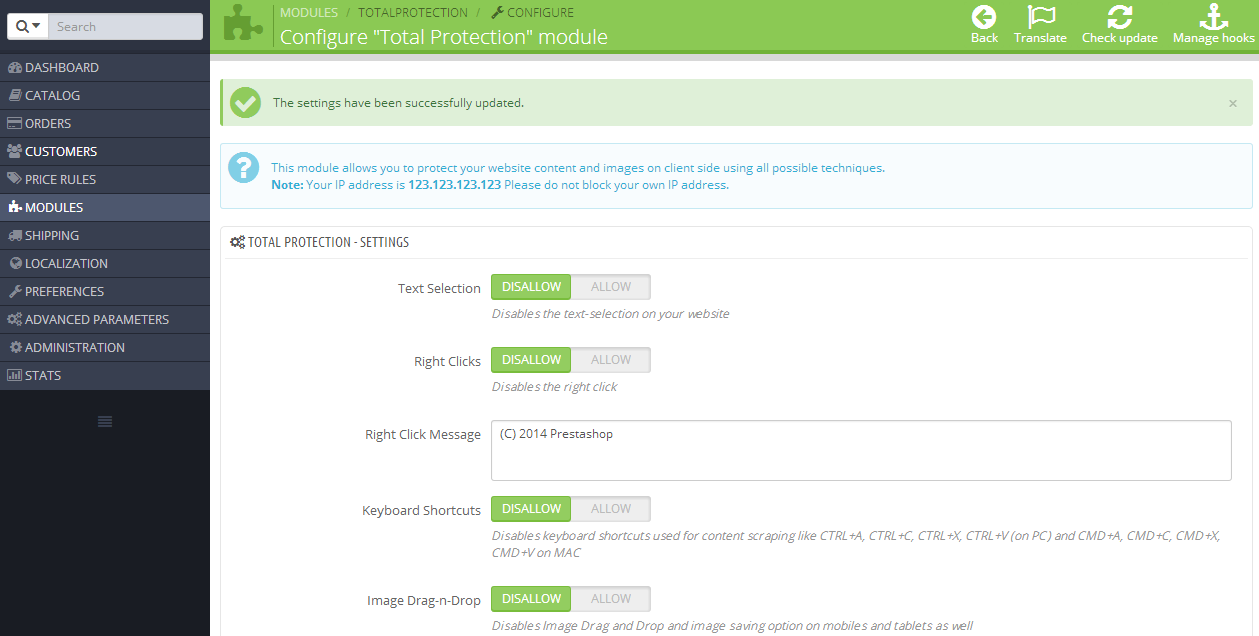
- Running PrestaShop? Prestashop Total Protection Pro covers the platform-specific holes attackers probe.
- For broader site defense across any CMS, SiteGuard Pro and the Webmaster Tools Suite give you monitoring and hardening in one place.
If you rely on backup plugins as part of your recovery plan (and you should), read how to harden WordPress backup plugins against site takeovers too. A
Cover image: Asian women holding packaging box ready to delivery,Entrepreneur or freelance Startup small business SME and online marketing. by pockethifi, licensed under BY 2.0 via Openverse.