Your backup plugin is the last line of defense when everything else fails. It is also, ironically, one of the most attractive targets on your entire site. Think about what a backup plugin can do: read every file, dump your full database, package your credentials, and ship the whole archive to a remote destination. If an attacker controls that plugin, they do not need to break into your site the hard way. They just ask your backup tool to hand over a copy.
This is not theoretical. In 2023, a widely used backup plugin with over five million installs shipped a vulnerability that let unauthenticated visitors download full site backups by guessing a predictable file path. In other tools, insecure default storage folders have exposed .zip archives to anyone who typed the right URL. The plugin meant to save you became the map to your entire infrastructure.
In this guide I will walk through exactly how to harden your WordPress backup plugin against site takeovers, based on years of running WordPress in production and cleaning up after the ones that went wrong. You will learn where backups leak, how to lock down storage and access, how to encrypt archives properly, and how to choose a plugin that will not become tomorrow's disclosure. This is a hands-on wordpress backup plugin security playbook, not a checklist of vague advice.
Key Takeaways
- Backup archives are full-privilege data dumps. Treat them like passwords, not like log files.
- Never store backups inside the public web root. Predictable paths are the single most common leak.
- Encrypt archives with a key that never lives on the same server, so a stolen backup is useless.
- Restrict who can trigger, download, or restore backups using capabilities, IP allowlists, and 2FA.
- Follow a 3-2-1 backup strategy so one compromised copy never means total loss.
- Audit the plugin itself before you trust it with root-level access to your data.
Why Backup Plugins Are a Prime Attack Surface
A backup plugin sits at a strange intersection of power and neglect. It has some of the highest privileges on the site, yet most admins install it, run one backup, and never look at it again. That gap between capability and attention is exactly what attackers exploit.
Here is what a compromised backup plugin gives an attacker:
- Your full database, including hashed passwords, user emails, API tokens stored in options, and session data.
- Every PHP file, including
wp-config.phpwith your database credentials and secret keys. - Remote storage credentials, if the plugin stores S3, FTP, or Google Drive keys in the database.
- A restore mechanism, which can be abused to overwrite clean files with a backdoored version.
The three most common failure modes I see in the wild are predictable storage paths, missing capability checks on AJAX endpoints, and unencrypted archives sitting in a folder that Google eventually indexes. Each of these is fixable in under an hour. Before you install anything new, it is worth reading how to audit a WordPress plugin's security before you install it, because a backup tool deserves more scrutiny than almost any other plugin category.
Step 1: Get Your Backup Files Out of the Web Root
This is the single highest-impact change you can make, and most people skip it. If your backup archives live anywhere under /public_html, /wp-content/, or any web-accessible directory, they can potentially be downloaded by anyone who finds the URL.
The problem with predictable paths
Say your plugin stores backups at /wp-content/backups/. An attacker runs a simple loop guessing filenames like backup-2024-01-01.zip through backup-2024-12-31.zip. That is only 366 requests per year. With date-based naming, the entire year's worth of backups can be enumerated in seconds. If directory listing is enabled, they do not even need to guess.
How to fix it
- Move backups outside the web root entirely. If your site lives in
/home/user/public_html/, store backups in/home/user/backups/. Files above the web root cannot be served over HTTP no matter what URL is requested. - If you must keep them in web root, block access. Add a rule in your
.htaccessfile inside the backup folder:<FilesMatch "\.(zip|gz|sql|tar)$">Require all denied</FilesMatch> - Disable directory listing site-wide with
Options -Indexesin your root.htaccess. - Randomize filenames. A backup named
backup-a7f3d9e2c1b8.zipis unguessable in practice. Many quality plugins do this automatically. Verify yours does. - Prefer offsite storage. The best local backup is no local backup. Push archives to remote storage and delete the local copy once transfer is confirmed.
Step 2: Encrypt Archives So a Stolen Copy Is Useless
Moving files is defense in depth, but assume a copy will eventually leak. Encryption is what turns a catastrophic breach into a shrug. If your backup is a .zip protected only by a weak password, it is not encrypted in any meaningful sense. Standard ZIP encryption is trivially cracked.
What you want is AES-256 encryption applied to the archive before it ever leaves the server, with the decryption key stored somewhere other than the site itself.
A concrete workflow
Here is a setup I run on a client site that handles customer data:
- The backup plugin generates a full archive locally.
- A post-backup hook encrypts it with
gpg --symmetric --cipher-algo AES256using a passphrase stored in a server environment variable, not in the database. - The encrypted file is pushed to an S3 bucket in a different region.
- The local copy is deleted.
- The decryption passphrase is stored in a separate password vault, offline from the site.
If an attacker steals the S3 bucket contents, they get .gpg blobs and nothing else. If you manage secrets across multiple systems, it is worth reading how to safely migrate to a self-hosted password manager so your encryption keys do not end up in a spreadsheet somewhere.
Step 3: Lock Down Who Can Trigger and Restore Backups
A backup plugin exposes several action endpoints: create a backup, download a backup, restore a backup, and configure remote storage. Every one of these needs a capability check. A shocking number of vulnerabilities come down to a developer forgetting a single current_user_can() call on an AJAX handler.
You cannot rewrite the plugin, but you can control the environment around it:
- Limit backup capabilities to a single admin role. Do not let editors or shop managers touch the backup UI. Use a role editor to strip
manage_optionsfrom anyone who does not strictly need it. - Enforce two-factor authentication on every account that can access the backup dashboard. An admin password leak should not equal a backup theft.
- Restrict the admin area by IP. If your team works from known addresses, an IP allowlist on
/wp-admin/stops most automated attacks cold. Tools like WordPress IP Blocker Pro let you allowlist trusted ranges and block hostile ones without editing config files by hand. - Rate-limit and monitor admin-ajax.php, since that is where many plugin actions route.
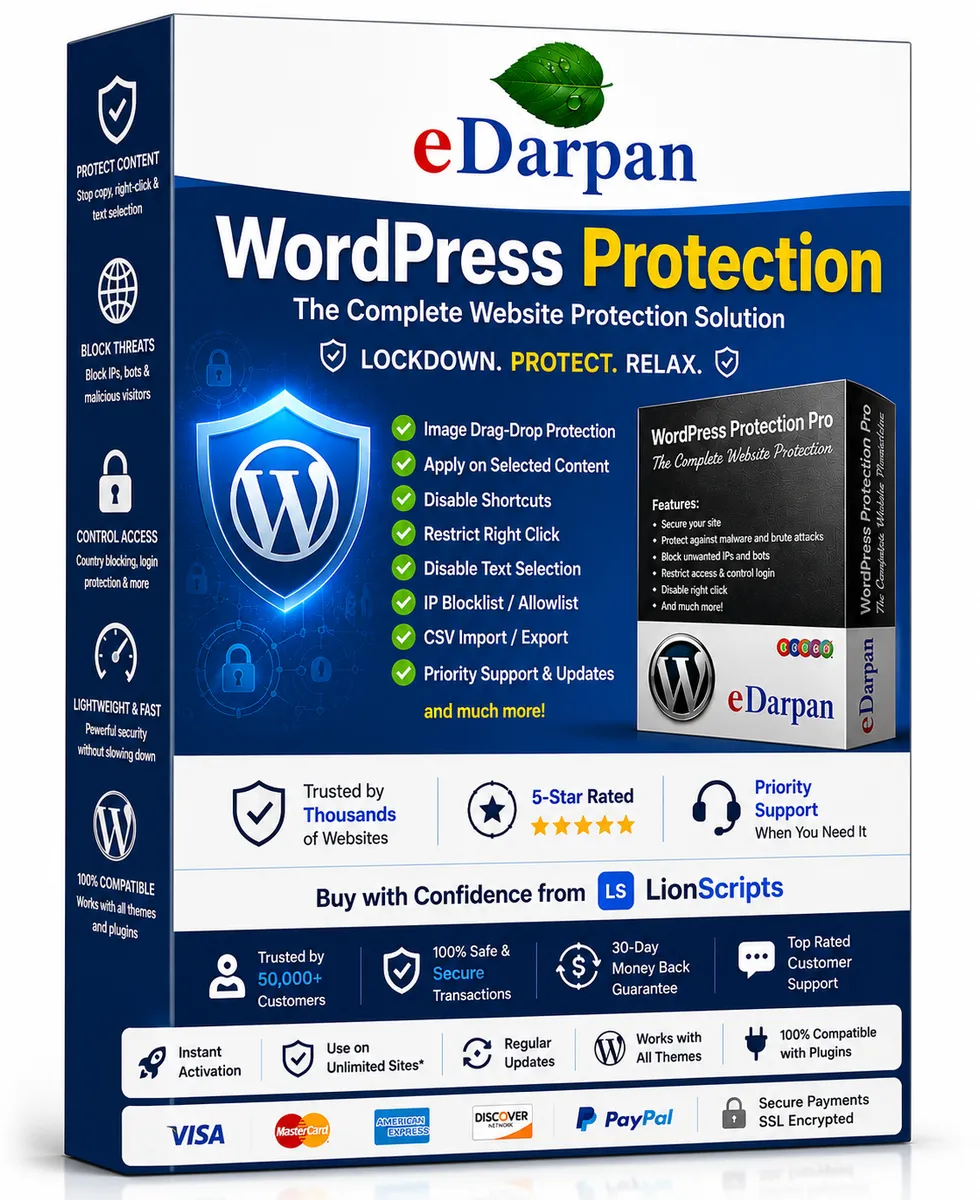
For a broader hardening layer that sits above any single plugin, a dedicated security suite such as eDarpan WordPress Protection or SiteGuard Pro can enforce login protection, file integrity monitoring, and request filtering across your whole install. Browse the full range in the WordPress plugins category if you want to compare options.
Step 4: Compare Backup Plugin Security Models
Not all backup plugins take security seriously, and the differences matter. Below is a comparison of the security-relevant features you should evaluate, using a generic feature matrix rather than naming specific vendors, since capabilities change between versions.
| Security Feature | Basic Free Plugin | Mid-Tier Plugin | Hardened Premium Plugin |
|---|---|---|---|
| Storage outside web root | Rarely | Optional | Default |
| AES-256 archive encryption | No | Weak ZIP password | Yes, key separated |
| Randomized filenames | No | Sometimes | Always |
| Capability checks on all endpoints | Inconsistent | Mostly | Audited |
| Encrypted remote credential storage | Plaintext in DB | Obfuscated | Vault or env-based |
| Restore integrity verification | No | Checksum only | Signed archives |
The takeaway is not that free plugins are always bad. It is that you must know which column your plugin lives in and compensate for whatever it lacks. A free plugin plus manual GPG encryption and offsite storage can be more secure than an expensive plugin used carelessly.
Step 5: Protect the Remote Storage Credentials
Here is a scenario that plays out constantly. An admin connects their backup plugin to a cloud storage account using a full-access API key. That key gets stored in the WordPress options table in plaintext. Six months later the database leaks through an unrelated SQL injection. Now the attacker has your entire cloud storage account, including backups of every other site you host there.
Fix the blast radius before it happens:
- Use scoped credentials. Create an S3 bucket policy or IAM user that can only write to one specific bucket and cannot delete or list other buckets.
- Prefer write-only keys where possible. The backup plugin needs
Cover image: Innovate Maryland Emerging Technology Center by MDGovpics, licensed under BY 2.0 via Openverse.