Programmers type between 6,000 and 10,000 keystrokes a day. If you have ever felt a dull ache creep up your forearm after a long refactor, you know that number is not abstract. Repetitive strain injury is one of the leading reasons senior engineers step away from hands-on coding, and voice input has quietly become a legitimate way to keep working without grinding your wrists into dust.
Here is the surprising part: modern AI dictation is fast enough to keep up with real speech, and it is now smart enough to understand programming syntax. We are no longer talking about the clumsy "period new line" dictation of a decade ago. With the right setup, you can say "for loop over the users array" and get clean, formatted code. You can dictate a commit message, a docstring, or a bug report without touching the keyboard at all.
This guide walks through setting up AI dictation for coding on Linux, Windows, and macOS. I have used every tool mentioned here in a real editor, on real projects, and I will be honest about where each one falls apart. By the end you will know which stack fits your machine, how to configure it, and how to avoid the mistakes that make voice coding frustrating instead of freeing.
Key Takeaways
- Two layers matter: a speech-to-text engine (Whisper, native OS dictation, or a cloud API) and a command layer that translates speech into editor actions.
- Local models win on privacy and cost. Whisper running on your GPU costs nothing per word and never sends your source code to a server.
- Talon Voice is the gold standard for full hands-free coding, but it has a steep learning curve of roughly two weeks.
- You do not need a perfect setup to start. Native OS dictation plus a few custom snippets covers 60% of the value in 20 minutes.
- Expect a slowdown for the first week. Dictation is a skill; most people match their old typing pace within 10 to 15 hours of practice.
What AI Dictation for Coding Actually Means
Dictation for prose is a solved problem. You speak, words appear. Coding is harder because code is not spoken English. It is full of symbols, camelCase, indentation, and structure that no natural sentence contains. So a good coding dictation setup has two distinct jobs.
The first job is speech recognition: turning your voice into a stream of words. The second job is command interpretation: turning phrases like "snake case user profile" into user_profile, or "def get user" into a Python function stub. Most people who try dictation and give up only set up the first layer, then wonder why it feels like fighting the tool.
The three approaches
- Native OS dictation. Built into Windows, macOS, and available via extensions on Linux. Zero cost, decent accuracy, no code awareness.
- Local AI models. OpenAI's Whisper or faster forks running on your own hardware. Excellent accuracy, full privacy, works offline.
- Voice command frameworks. Talon Voice, Serenade, or Cursorless. These add the command layer that makes hands-free coding genuinely productive.
The best real-world setups combine a strong recognition engine with a command framework. I will show you how to layer them per platform below.
Comparing the Main AI Dictation Tools for Developers
Before you install anything, it helps to see the tradeoffs side by side. I scored these on the criteria that actually matter when you are staring at a terminal at 11pm trying to close a ticket.
| Tool | Platforms | Code awareness | Privacy | Cost | Learning curve |
|---|---|---|---|---|---|
| Talon Voice | Win, Mac, Linux | Excellent | Local (Conformer engine) | Free / $15+/mo Pro | High (~2 weeks) |
| Serenade | Win, Mac, Linux | Very good | Local or cloud option | Free / open source | Medium |
| Whisper (local) | Win, Mac, Linux | None (raw text) | Fully local | Free | Low to medium |
| Native OS dictation | Win, Mac | None | Varies (some cloud) | Free | Very low |
| Cloud API (e.g. Deepgram) | All (via app) | None (raw text) | Cloud only | ~$0.0043/min | Medium |
My short recommendation: if you want the deepest hands-free experience and are willing to invest time, go Talon. If you want strong accuracy with less ceremony, run Whisper locally and pair it with a text-expansion tool. If you just want to reduce keyboard load today, start with native dictation and iterate.
How to Set Up AI Dictation for Coding on Linux
Linux has no first-party dictation, which sounds like a disadvantage but is actually a gift. It forces you toward the best tools, and everything integrates cleanly at the command line.
Option A: Whisper with nerd-dictation
This is my daily driver on a Fedora workstation. It runs entirely offline and feels responsive on any machine with a modern GPU.
- Install the dependencies:
sudo apt install python3-pip ffmpeg(or the dnf/pacman equivalent). - Install a fast Whisper implementation:
pip install faster-whisper. On an RTX 3060 thesmall.enmodel transcribes near real time; themediummodel is more accurate but adds latency. - Clone
nerd-dictation, a lightweight front end that pipes your microphone into the model and types the output into whatever window has focus. - Create a config file that defines text substitutions. Map "open paren" to
(, "arrow function" to() =>, and "log it" toconsole.log(). This is your poor man's command layer. - Bind a keyboard shortcut to toggle dictation on and off so you can pause without killing the process.
The substitution file is where the magic lives. After a week I had about 80 mappings covering the symbols and boilerplate I use most. Dictating a React component went from clumsy to fast enough that I stopped noticing the tool.
Option B: Talon on Linux
Talon runs on Linux and ships with the same Conformer speech model it uses everywhere. Install it, add the community talonhub/community command set, and you get hundreds of coding commands out of the box. The catch on Linux is that Talon works best under X11; Wayland support has improved but still has rough edges with certain window managers.
Whatever you install, vet it first. Voice tools need microphone access and often accessibility permissions, which is exactly the kind of thing worth checking before you trust it. Our guide on how to audit open-source software before adding it to your stack is a good pre-flight checklist. If you build workflows around symlinked config directories, the concepts in Windows Symlink Creator Pro have direct Linux parallels worth knowing.
How to Set Up AI Dictation for Coding on Windows
Windows gives you two solid starting points and a strong upgrade path.
Step 1: Try native Voice Access first
Windows 11 includes Voice Access, which is far better than the old Windows Speech Recognition. Press Win + Ctrl + V to enable it, then run the guided tutorial. It handles dictation and basic navigation, and it processes speech on-device on supported hardware.
- Open Settings, go to Accessibility, then Speech, and turn on Voice Access.
- Download the on-device speech model when prompted so your code never leaves the machine.
- Test it in Notepad by dictating a sentence, then a line of code, to feel the gap between prose and syntax.
Voice Access alone will not make you a hands-free coder, but it proves the concept and costs nothing.
Step 2: Add Talon or Serenade for real coding
For actual development I run Talon Voice on Windows. Installation is a standard installer, and the community command set gives you spoken commands for VS Code, JetBrains IDEs, and the terminal. Serenade is the friendlier alternative: it installs an IDE extension and understands commands like "add function hello" that generate correctly formatted stubs.
Here is a worked before-and-after. Writing a small Python function by keyboard, I timed myself at roughly 22 seconds including the docstring. With Serenade, saying "add function calculate total with parameters items and tax" produced the signature, body indentation, and cursor placement in about 9 seconds. The catch: it took me three tries the first day because I had not learned the phrasing yet. By day four it was faster than typing.
Step 3: Manage your snippets and config safely
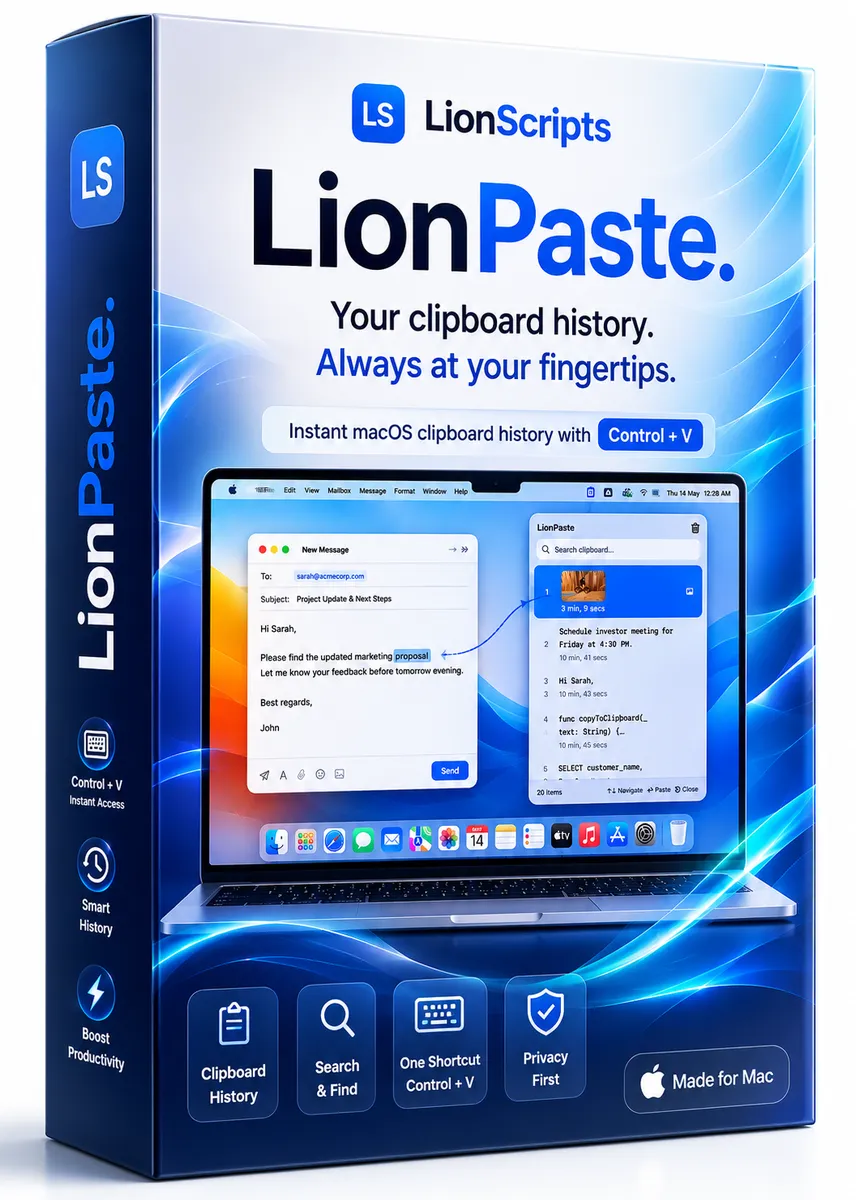
Your command definitions and text expansions become genuinely valuable over time. Keep them in version control and back them up. If you juggle many reusable snippets across projects, a clipboard and snippet manager like LionPaste pairs surprisingly well with voice input, since you can dictate a trigger and paste a large block instantly. For long-term config preservation, some developers use Lion's Legacy to ensure their personal tooling survives machine changes.
How to Set Up AI Dictation for Coding on macOS
macOS has the smoothest native dictation of the three platforms, and Apple Silicon makes local models fly.
Step 1: Enable enhanced dictation
- Go to System Settings, then Keyboard, and turn on Dictation.
- Enable the option to download the language model so dictation works offline and never sends audio to Apple.
- Set a shortcut, such as pressing the
Controlkey twice, to toggle it fast.
Apple's dictation punctuates well and handles casing better than most, but like all native tools it has no idea what a function is.
Step 2: Run Whisper locally on Apple Silicon
The M-series chips run Whisper extremely well through whisper.cpp, which uses the Neural Engine and GPU. On an M2 MacBook Air the base.en model transc
Cover image: Innovate Maryland Emerging Technology Center by MDGovpics, licensed under BY 2.0 via Openverse.