Here's a number that should worry any operations lead: in a 2024 survey of knowledge workers by Salesforce, 55% of employees who use generative AI at work admitted to doing so without their employer's approval, and 40% said they used tools their company had explicitly banned. That means the average mid-size company likely has dozens of ungoverned AI tools quietly ingesting customer data, source code, and confidential documents right now, and nobody in legal or IT can name them all.
The risk isn't hypothetical. When an employee pastes a client contract into a free chatbot to "summarize the key terms," that text may be retained, used for model training, or exposed in a breach. Samsung learned this the hard way in 2023 when engineers leaked internal semiconductor source code into ChatGPT on three separate occasions within a month. The company banned the tool company-wide days later. By then the data was already gone.
This article is a practical field guide to employee AI tool compliance: how to discover what your team actually uses, how to assess the legal and security exposure of each tool, and how to build a governance program that reduces risk without killing the productivity gains AI genuinely delivers. You'll get a worked audit example, a comparison of discovery methods, and a step-by-step walkthrough you can start this week.
Key Takeaways
- Shadow AI is the default, not the exception. Assume your employees are using tools you haven't approved and audit accordingly.
- Data flow is the real risk, not the tool. Focus your audit on what data leaves the building and where it lands.
- Read the data-use and retention clauses in each tool's terms. "We may use inputs to improve our services" is a red flag for confidential work.
- Combine network-level discovery with an honest employee survey. Neither alone gives you the full picture.
- Write a policy that offers approved alternatives. Bans without options just push usage further underground.
- Re-audit quarterly. The AI tool landscape shifts monthly, and so does your exposure.
Why Employee AI Tool Compliance Is a Legal Problem, Not Just an IT One
The instinct is to treat unauthorized AI use as a security ticket. It's bigger than that. When employee AI tool use goes wrong, the fallout usually lands in four legal buckets.
- Data protection violations. Under GDPR, feeding EU personal data into a tool without a lawful basis or data processing agreement can trigger fines up to 4% of global revenue. Similar exposure exists under India's DPDP Act and California's CCPA.
- Breach of client confidentiality. Many B2B contracts include clauses barring disclosure of client data to third-party subprocessors. A free AI tool is a subprocessor your client never approved.
- Intellectual property leakage. Trade secrets lose legal protection once they stop being secret. Paste your proprietary algorithm into a chatbot and you may have voided your own trade-secret claim.
- Copyright and output liability. AI-generated content and code can reproduce licensed material. If your product ships that code, you inherit the liability.
That last point deserves attention from engineering teams especially. AI coding assistants introduce subtle defects and license contamination at a rate most managers underestimate. We covered the mechanics in why AI-generated code has 70% more bugs and how to fix it, and the security angle in how to vet AI coding assistants for security flaws before you trust them. Both are worth reading before you sign off on any coding tool.
Step 1: Discover Every AI Tool Your Team Actually Uses
You cannot audit what you cannot see. Discovery is the hardest part because the most common tools are browser-based, free, and require no install approval. Here's how to build a complete inventory.
Run a blameless employee survey
Start with people, not logs. Send a short, anonymous survey that makes clear this is about safety, not discipline. Ask:
- Which AI tools have you used for work in the last 90 days? (list common ones plus an "other" field)
- What kinds of tasks do you use them for?
- Have you ever pasted internal documents, code, or client data into one?
- Which tool would you struggle to give up, and why?
The fourth question matters most. It tells you where the real productivity value sits, so your eventual policy can preserve it rather than fight it.
Inspect network and DNS traffic
Your firewall or DNS resolver logs outbound requests. Query them for known AI endpoints such as api.openai.com, claude.ai, gemini.google.com, copilot.microsoft.com, and the growing list of niche tools. A DNS export filtered to AI domains will surface tools no survey captured.
Audit browser extensions
Browser extensions are the sneakiest vector because they can read every page a user visits, including internal dashboards and email. AI writing assistants, meeting transcribers, and "summarize this page" extensions frequently ship data to servers you've never vetted. We wrote a dedicated guide on this: how to lock down AI browser extensions before they hijack data. Pull an extension inventory from your managed browser policy or endpoint management tool.
Check SaaS and expense records
Paid AI subscriptions show up on corporate cards and in SSO logs. Search expense reports for "AI," "GPT," "Copilot," and vendor names. Any recurring charge under $30 that nobody can explain is a candidate.
Comparing AI Tool Discovery Methods
No single discovery method is complete. Here's how the main approaches stack up so you can decide where to invest first.
| Method | Coverage | Effort | Catches free tools? | Catches browser tools? |
|---|---|---|---|---|
| Anonymous survey | Medium | Low | Yes | Yes |
| DNS / firewall logs | High | Medium | Yes | Partial |
| Browser extension audit | Medium | Medium | Yes | Yes |
| Expense / SSO review | Low | Low | No | No |
| Endpoint monitoring agent | Very High | High | Yes | Yes |
The pragmatic combination for most teams is a survey plus DNS logs plus a browser extension audit. That trio catches roughly 90% of usage at a fraction of the effort of deploying full endpoint monitoring, which carries its own privacy and morale tradeoffs.
Step 2: Classify the Legal Risk of Each Tool
Once you have an inventory, score each tool on the two dimensions that actually predict legal trouble: data sensitivity (what employees feed it) and vendor data handling (what the vendor does with it).
Read the terms that matter
Skip the marketing page and open the terms of service, privacy policy, and any "enterprise" or "data processing addendum." Look specifically for:
- Training use. Does the vendor use your inputs to train models? Free consumer tiers almost always do unless you opt out.
- Retention period. How long is data stored, and can you request deletion?
- Subprocessors and location. Where does data physically go, and who else touches it?
- Enterprise controls. Is there a paid tier with a no-training guarantee and a signed DPA?
The difference between tiers is stark. A free chatbot may train on everything you type; the same vendor's enterprise plan often contractually promises zero training and 30-day retention. This is why "which tool" matters less than "which plan."
Build a simple risk matrix
Rate each tool as Low, Medium, or High on both axes. A meeting transcriber that records client calls and trains on the audio is High/High and needs immediate action. A local calculator app is Low/Low and can be ignored. The interesting cases sit in the middle, where a small config change can drop the risk dramatically.
A Worked Example: Auditing a 40-Person Marketing Agency
Let's make this concrete. Say you run operations at a 40-person agency. Your survey and DNS logs surface these tools in active use:
- ChatGPT free tier — 31 employees, used for copy drafting and client email summaries
- A browser "grammar AI" extension — 22 employees, reads every page including the CRM
- An AI meeting notetaker — 4 account managers, auto-joins client Zoom calls
- GitHub Copilot — 3 developers on the web team
- A free image generator — 12 employees, for social mockups
Now you score them. The meeting notetaker is your worst offender: it records confidential client strategy calls, and its free tier trains on transcripts. That's 4 users creating High/High exposure on your most sensitive conversations. The grammar extension is next, because it silently reads CRM records containing personal data, a likely GDPR problem.
Here's the before/after. Before: five ungoverned tools, at least two leaking regulated client data, zero contracts in place. After a two-week remediation: you kill the notetaker and replace it with a paid tool that offers a DPA and no-training guarantee, you remove the grammar extension via browser policy and approve a vetted alternative, you move all 31 ChatGPT users to a Team plan with training disabled, and you keep Copilot but route its output through a mandatory code review gate.
Net result: the same productivity, a documented policy, signed data agreements, and a risk profile you can defend to a client's procurement team. Total spend was roughly $12 per user per month for the ChatGPT Team upgrade and a comparable notetaker plan. That's a rounding error against a single GDPR fine.
Step 3: Reduce Exposure Without Killing Productivity
The failed approach is a blanket ban. Employees who found real value in a tool will simply move to their phones or personal laptops, and you lose all visibility. The dur
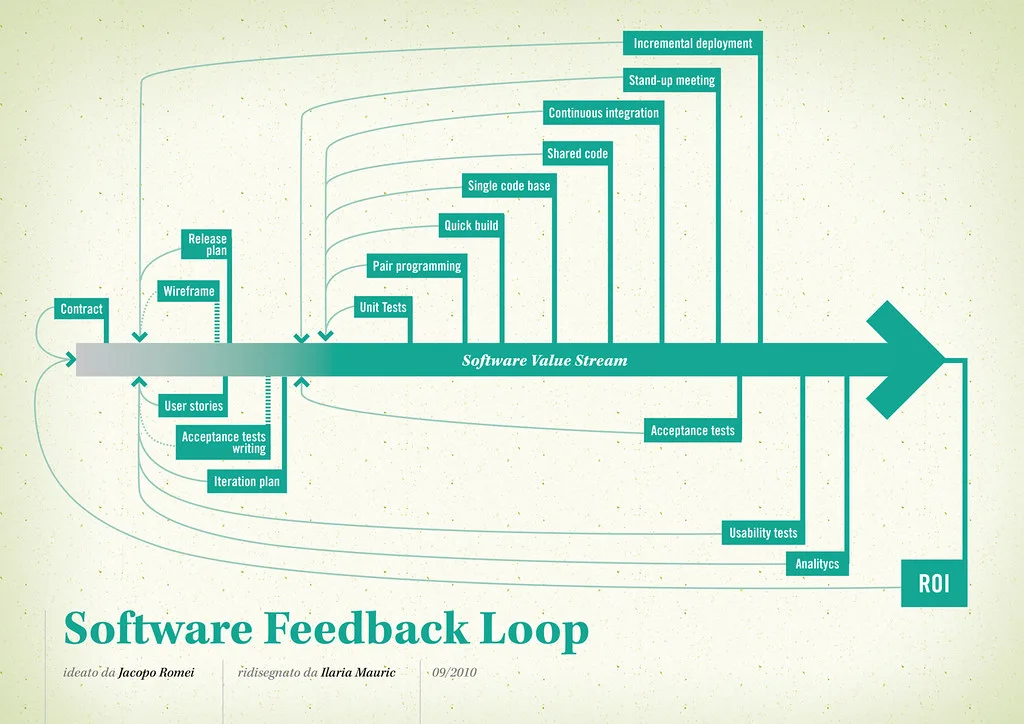
Cover image: Software value feedback loop by jakuza, licensed under BY-SA 2.0 via Openverse.